
From navigation agent to reliable computer use
Building on UI-Venus and UI-Venus-1.5, UI-Venus-2 takes a further step toward general-purpose computer use by systematically scaling the environments, tasks, and feedback available to the agent. The agent observes the current interface, reasons about the task state, executes an action, and incorporates environmental feedback into its next decision — a unified closed loop that runs across mobile applications, dynamic websites, and full desktop operating systems.
Built for real work across GUI interfaces
Six capabilities, one agent. Animated schematics sketch what each capability does — real end-to-end executions are replayed in the trajectory demos below.
Rename & share a cloud file
“打开夸克 App,在网盘中将最新文件重命名为“测试文档_1213”,设置加密分享并生成链接,最后复制。”
Constrained product hunt
“Find best-selling dark blue denim jeans in boys' size 10 Husky that cost between $24 and $52 on Amazon.”
Pixel-art asset from a tutorial
“Using one embedded pixel-art sample from the supplied tutorial as the source, create a clean sprite in GIMP and export it.”
Find the exact pixel
“Toggle visibility of the ‘Background copy’ layer in the Layers panel.”
Slide, rotate, click — verified
“Drag the slider so the puzzle piece fits the gap, then confirm.”
Knows when to ask first
“Free up disk space — just delete whatever we don't need.”
Real trajectories, replayed step by step
Unedited execution traces from real environments. Every step shows the exact screenshot the model saw, the reasoning it produced, and the action it emitted — drawn where it happened on screen. Use the rail to scrub, or press play and watch the whole run.
Loading trajectories…
The trajectory data couldn’t be loaded. If you are viewing this page from a local file,
serve it over HTTP first — e.g. python3 -m http.server — then reload.
What’s new in 2.0
Four tightly coupled advances make environment coverage, task quality, outcome verification, and self-assessment work together as one system.
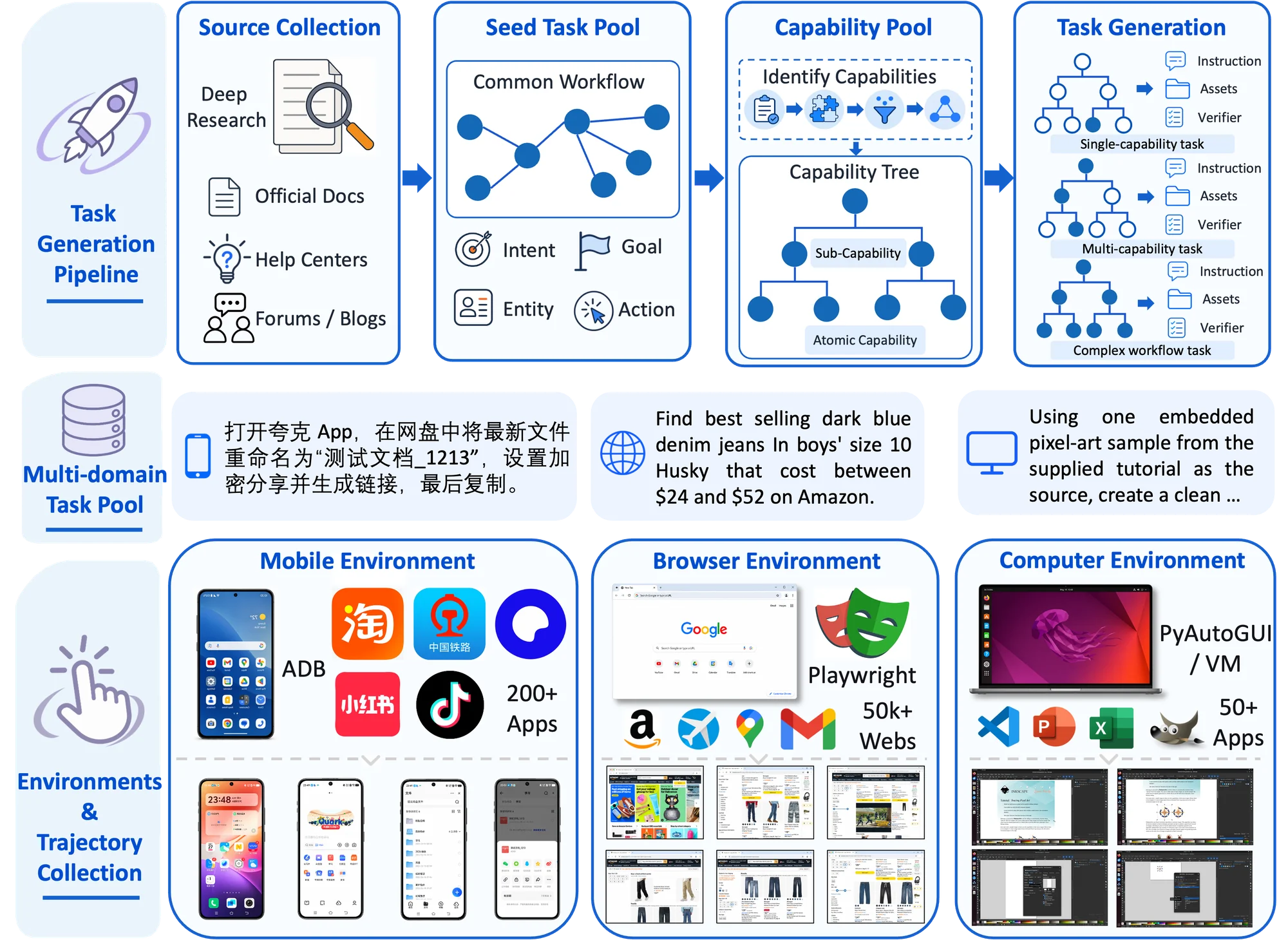
Scaled multilingual mobile environments
A substantially expanded executable mobile pool covering Chinese and English app ecosystems, paired with a deep-research-driven query-generation strategy that grounds task queries in real application functionality — improving the accuracy, validity, and executability of generated instructions.
Computer use, built from the ground up
Dedicated desktop operating-system capabilities constructed from scratch through computer-use data collection and task-specific training, extending the UI-Venus family to mobile, web, and OS interaction in one unified end-to-end agent.
Trace- and sample-level verification
Trace-level verification judges task completion from task-relevant visual keypoints and multi-model evidence, while sample-level verification assesses reasoning–action consistency and task alignment before execution for fine-grained supervision and intervention.
Open-source foundation agent
Full-parameter weights and evaluation infrastructure make UI-Venus-2 a capable, efficient, and reproducible foundation for research on reinforcement learning, reliable verification, and general-purpose computer use.
One unified training pipeline, five task families
UI-Venus-2 is initialized from Qwen3.5-9B and Qwen3.6-27B and trained on a deliberately complementary mixture of Grounding, CAPTCHA, Mobile, Web, and Computer tasks: grounding provides fine-grained spatial perception, CAPTCHA offers controlled and verifiable interaction supervision, and the navigation families supply realistic multi-step experience.
Multimodal Mid-Training
Large-scale trajectory-based mid-training over simulated mobile, web, and OS environments, with human–discriminator collaborative verification filtering invalid or ambiguous interactions, plus programmatically synthesized grounding and CAPTCHA supervision.
Offline RL
Step-level RL trajectories for Mobile, OS, and Web optimize state-aware action selection and execution reliability, while verified CAPTCHA and grounding instances embedded in realistic interfaces teach precise localization under visual clutter.
Multi-teacher On-policy Distillation
Domain-specialized teachers are consolidated into a single unified policy. Structured action-aware supervision and teacher-side action-type hints concentrate distillation on the executable behavior that governs each environment transition.
Benchmark results
Key results per domain, with the strongest published baselines for context. Full comparison tables and metric definitions are available under each chart group. A dash denotes a result that is not currently reported in the technical report.
Online, interactive mobile-agent benchmarks spanning MobileGym, VenusBench-Mobile, AndroidWorld, MobileWorld, KnowUBench, and MemGUI.
Full comparison table — Mobile Use
Open-ended tasks in real computer environments: desktop and web applications, OS-level operations, and long-horizon professional workflows.
Full comparison table — Computer Use
End-to-end web navigation across WebVoyager, Online-Mind2Web, REAL, and the long-horizon cross-site Odysseys benchmark with rubric-based scoring.
Full comparison table — Web Navigation
Element localization across high-resolution professional software, mobile / web / desktop interfaces, and reasoning-heavy or refusal-aware instructions. UI-Venus-1.5 marks our previous generation.
Full comparison table — GUI Grounding
Pass@1 evaluation on VenusBench-CAPTCHA and four public benchmarks: Spatial-CAPTCHA-Bench, MCA-Bench, NextGen-CAPTCHAs, and Open CaptchaWorld. VenusBench-CAPTCHA contains 219 images across eight real-world interaction types.
Full comparison table — CAPTCHA Solving
Capable, and careful about it
OSHarm and OSBlind evaluate whether an agent executes harmful outcomes under adversarial or benign-looking instructions in realistic computer environments. Both report Attack Success Rate (ASR), where lower is better.
Safety is a first-class capability
Unlike GUI agents optimized primarily for task completion, UI-Venus-2 treats safety as a first-class capability and incorporates safety-aware mechanisms for controlled execution of consequential actions.
Full comparison table — Safety
ASR is the frequency of harmful outcomes; lower is better. Charts show representative baselines, while the full table includes every model reported in the current technical report.
BibTeX
If you find UI-Venus-2 useful, please cite the technical report.
@article{uivenus2026,
  title   = {UI-Venus-2 Technical Report},
  author  = {{Venus Team, Ant Group}},
  journal = {arXiv preprint arXiv:2609.00028},
  year    = {2026},
  url     = {https://arxiv.org/abs/2609.00028}
}